Rhythmic Building Bricks or Blocks are often used as compositional tools in elementary music classrooms.
Developed by Carl Orff's fellow teacher, Gunild Keetman, these simple 2-beat patterns use quarter notes, quarter rests, and paired eighth notes (and sometimes a half note). These are elemental rhythms most commonly found in children's rhymes, fingerplays, and simple songs and can be combined to create more complex rhythmic patterns.
Rhythmic building bricks break down composition into small, manageable units, enabling students to create their own pieces from simple patterns. This approach reduces the intimidation of composing and encourages creativity through structure. By experimenting with different combinations of rhythmic bricks, students explore concepts like repetition and arrangement, fostering creative ownership of their musical output. The use of repeated patterns helps students internalize how repetition contributes to musicality and familiarity. Additionally, rhythmic bricks allow for differentiation, as teachers can adapt pattern length, rhythmic complexity, and instrumentation to meet diverse learning needs.
Specific Learning Goals
Rhythm: Building bricks should follow natural speech (the way a word is spoken).
Repetition: Musical themes often repeat.
Form Exploration: Try various elemental forms of aabb, abab, abba, aaab, and abac.
I Get It, Now What?
Rhythmic Building Bricks/Blocks are often thematic and should always use natural speech (which is why names don't work well as there are too many accents and pickups that don't fit the elemental quarter notes and eighth notes).
Small groups of students are given 4 building bricks (this will create an 8-beat rhythm). The rhythms should be ones already learned. They practice arranging them, speaking them, adding body percussion and perhaps transferring these to non-pitched percussion. They may be used as a contrasting section to a short speech piece or song.
These candy building bricks/blocks are perfect for fall and winter holidays and include some variations including sixteenth notes! Please note this will force a copy.
I struggle with all the Halloween themed things I used to do and no longer include as I have students who do not celebrate Halloween. I love spooky season and incorporate spiders, monsters, and other "Halloween-adjacent" activities into this time of year but always with a curricular focus. And if I don't have it, I make it. My third graders learn recorder every year and this year's group is just a wee bit behind other years, for whatever reason. Wonderful singers, and wonderful musicians, just not picking up on recorder as quickly as some other groups. So, I needed a quick piece to put together and have always loved the book, Creepy Carrots! Get the full slide set, with the animated book, here (free!). I wrote this yesterday and did the activity with two classes, who walked out the door singing the tune- love when that happens! Easy, accessible, and diversified for students who need to work on EG or BAG passages, or they can play everything, BAGE!
I am always looking for songs that help my recorder students with specific areas - and often end up writing my own pieces to fit their needs. Since switching the starting pitches from BAG to GE I have been delighted that beginning with G and E opens up so much bitonic and tritonic (SM and SLM) songs and once we add low D we have access to some wonderful pentatonic material!
We are working on some pre-improvisational ideas and so The House Around the Corner was born this week! My students needed more practice with low E, and they were clamoring for something scary and spooky. This song can go in various directions - spooky or with a more autumnal/wintry theme.
I sang this song to them while playing the accompaniment.
Then I displayed these four 4-beat rhythm cards.
As we have been working on something we call the Wizard's Challenge using In the Hall of the Mountain King, I tell the students this rhythm might be familiar. Then I sing it using the word "dude" (which is what we "whisper" when playing recorder) and their little minds are blown that this is the rhythm of the melody repeated over and over. Then we play the first card (top left) only using "E". Then play through each subsequent card using "E." Play the top two cards, then the bottom two, then the full 16-beat phrase.
I change the bordun to quarter notes E B C B, which sounds very spooky, and we play the full phrase using E.
Next, change the quarter notes to G. Play full phrase.
Finally, change the 3rd card (four 8th note pairs) to B and have students work on the transition from third card to final card (transitioning from B to E) and then we play the full phrase.
Perform as A (song), B (recorder melody), A again. Students could also play the melody as it is a simple La Do Re Mi song. If you have Carol King's Recorder Routes you could combine this with Who Has Seen the Wind, another LDRM song.
The students loved it and felt so successful! The next time we will work on improvising beats 2 and 4 of the third measure and will add zombie movement (as they requested), whistling tubes, flexatone, black scarves, and spring drums. They also want to add gongs, cymbals, and other things so it is sure to be a piece we will record to send home to families.
I needed a new song for sixteenth notes for this season, so this morning I wrote one. Enjoy! The game is similar to others and will be a quick and easy way for my students to work on playing octaves and sixteenth notes! Click this link for the google slide.
I love using In the Hall of the Mountain King but with little ones I do this activity. It is a fun activity using locomotor movement and a modified melody.
Older Students
If you have the book, In the Hall of the Mountain King, I start this lesson by reading the book.
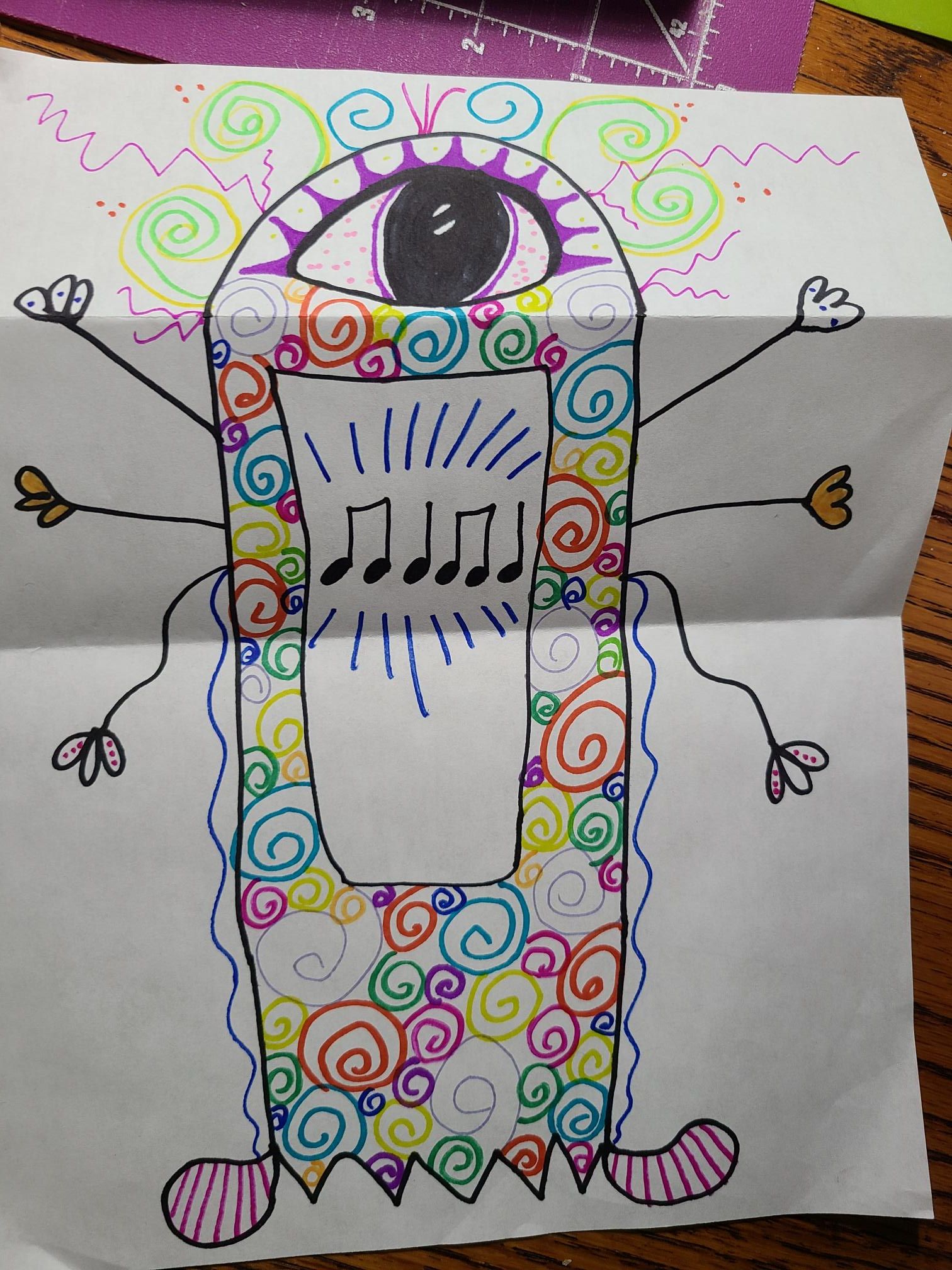
Create Music "Trolls" or "Troll Kings" or "Monsters":
Here is my example:
Step by step directions:
Some of my students creations:
Next, we learn this speech piece and perform it by opening the monster (high), closing it (low), turning around for "monster everywhere" and moving it side to side quickly for "fast" and slow for "slow", then running in place for "go go go".
Then we perform the speech piece with the book, Monster Trouble, every 3-4 pages. SO MUCH FUN!
I enjoy the costumes, trick or treating, and the silly, playful fun of Halloween. I have leaned more towards monsters in the past several years as they aren't really Halloween and can be use any time of year.
On my Patreon site there are SEVERAL posts using children's lit, songs, games, speech pieces, solo singing activities, etc. This is one recent massive post, with 3 embedded videos! Here is a pic of some of the things from that one post:
Did you know you can play the hand game, Sevens, along with In the Hall of the Mountain King? This is SO much fun! The game is from my Hands to Hands, Too Book:
Need a more visual demonstration of how to play the game? Here you go!
Movement/Body Percussion/Instruments with In the Hall of the Mountain King from Musication
Perfect for these times of not sharing instruments- this one is SO fun to add lots of various movement and/or instrument sounds from Music Packs!
Mmmm... pumpkin pie. Mmmm... pumpkin bread. Mmmm... pumpkin spice. A few weeks ago we were still in the 90 degree temps and I came across this fabulous pic:
Seriously, I do love everything pumpkin! I also love using the word pumpkin (a perfect eighth note pair) in many ways in the music classroom in the fall. It is also a very inclusive way to celebrate fall if you have students that do not celebrate Halloween. Here are a few of my favorites:
1. Pumpkin Chant
I just found this one yesterday and am already in love with this for my littles! It has such a cute ending and ties in nicely to the Lynn Kleiner song "Peek a Boo" to use with scarves. I also love this as a lead in to the book, Pumpkin Soup (see below).
2. Pumpkin Stew Song/Pumpkin Stew Book
I love this musical book-the cat plays bagpipes, the squirrel plays banjo, and the duck sings. Insert the song, Pumpkin Stew after each page. Click on the book to see it on Amazon. Here is a video with an idea for a game with solo singing to play with the song. I use this song with Kindergarten and First Graders:
I have a homemade fabric pumpkin with a zipper in the side and my students go on a hunt through the music room to find something small they can put in the pumpkin- mini containers of playdough, shaker eggs, castanets, finger cymbals, plastic spider and skull rings, markers, etc. have all made their way into our delicious stew!
3. Pass the Pumpkin
Check out the previous post here with the full activity and song. My kids LOVE this one!
4. Pumpkins and Ghosts Game
This one uses foam ghosts and pumpkins (Dollar Tree or Wal Mart has these). Perfect for eighth and quarter note rhythm exploration! Original post here.
5. Five Little Pumpkins
This is a well known chant and fingerplay. It is wonderful to act out, add scarves and movement, too! Click on the book to link to amazon.
This one is great for adding sound effects for each character.
8. Big Pumpkin Book
I have long loved this funny story of a witch who wants to make a pumpkin pie and can't get her pumpkin off the vine. Along comes a ghost who tries, and then a vampire and several other characters. Of course, it is the bat who finally gets it off the vine. Each time another character comes along students decide on an instrument sound for their character. Of course it is great for adding scarves, movement, and dramatic play also.
What are some of your favorite pumpkin activities?