See the Dragon Come has long been a favorite song and I finally got around to making two different sets of simple 2-beat building bricks for young students- one cartoon version, one traditional Chinese papercut version.
This is a favorite dance and I love using it to introduce syncopation! There are (at least) 2 versions although I think Version 2 is probably more historically accurate. The song and dance is a play party. Here is more information about this song and more here from the University of Arkansas with a field recording from 1953. The speech at the beginning of Version 1 is something I created with my students.
I love using these to get my students into movement and dance formations -I simply hold up the sign and students quietly (or silently) move into position. We practice moving into formations at the beginning of the school year and I use these often to get students quickly to where they need to be for various activities.
UPDATED - I made them with stick figures also so you have a choice of which ones to print & use.
Today we have a guest blog post from the awesome Melissa Fuller Flores. Be sure to check her out on instagram!
MANY thanks to Melissa for sharing her advice and dance adaptations using Pop Music with folk dancing!
You’ve probably seen this quote: “Be the teacher you needed when you were younger.” That has been my driving force ever since a student of mine, early on in my teaching career, asked, “How come the music that we hear in music class is different from what we hear outside music class?” A pit sank in my stomach. It made me think about my own school music experience as a kid, and I realized that not only was I missing something in my classroom, but that something from my own experience growing up was the same. I know as a Filipino-American in the 90s/2000s I would have had a greater sense of belonging and connection in what we were learning if we would have danced or sung anything from the Philippines. Or even just listened to Oops I Did It Again, anything Spice Girls, something with a boy band!
The easiest way I felt that I could incorporate this relatability for my students quickly was by pairing it with folk dances that my students already knew from their own culture. Which brings us to today!
🎶Break it Down Now Y’all🎶 (Choosing Dances/ Pop Songs)
How do I know if a folk dance is an appropriate level for my students? You know your students best. For kids newer to folk dancing, I choose dances that keep the same partner throughout the dance and song. Sometimes I adapt a folk dance to where the dance is pretty much the same, but without changing a partner. (I would be remiss if I didn’t mention that a good rule of thumb for all dance choices is that ritual dances, or dances of ritual origin, are always off limits to perform or practice in our classrooms.)
How will I know when my students are ready for me to add the pop songs to the folk dance? Before adding a pop song to a folk dance I make sure that the students have had loads of past experience with the dance; even to where I don’t need to call directions! Because when you do add a pop song, there can be tricky situations that can come up. And if the students have a deeper depth of knowledge about how the dance works, they will be able to adapt and improvise better.
How do you decide what songs to use? Sometimes I take the lead of what songs my students are singing from movies or youtube, what is popular on the Hot 100, and most of all: what is Kidz Bop recording? Sometimes I start with Kidz Bop and seek out the original recording to check and hear if the original recording is good to have in your classroom. If a student suggests a song and you feel like it is questionable, ask a student who is in high school or college to have a listen and tell you if there are any hidden meanings in the lyrics.
Does tempo matter? Songs that are closer in tempo to the traditional music allow for a more seamless transition for students who are starting out layering folk dances with pop songs. But when the tempo really differs from the traditional music tempo, it opens up a chance to see more collaboration, creativity, and adaptability from your students.
I have my song/dance, how do I choose which song/dance would go well with it? Check if they are in the same time signature and they have similar forms*. (See the next section about form). To check if they line up I honestly just sit down, listen to the pop song while using my fingers to dance out the moves along with the directions, and visualize how it could line up. I recommend doing this while sitting somewhere comfy and not while driving and/or in traffic…seriously learn from my mistakes y’all! Another trick is to find a YouTube video of people dancing the folk dance, put it on mute, and start the music and see how it overlays.
Form*: Not all song lyrics and sections match up perfectly with the original folk dances. Sometimes it is off by 8 or 16 beats. When this occurs, have students repeat sections of the folk dance until the next section. If it doesn't line up, check to see if these next two tricky spots apply.
Introductions: I typically wait for the first verse of the song before we start dancing. Not only for syncing purposes, but also so the students can get the tempo and feel. Also, I like for the kids to really enjoy the song before we start dancing away.
Bridges: Leading into the bridge I call, “Make it up!” During this time we either just pause and wait, or more times than not improvise dance moves and vibe with the music. Then when the next verse comes up, I call, "1, 2, ready go!". Make sure to set safe expectations before the song even starts. I’ve made the mistake of forgetting to do this, so you can imagine all of the almost accidents that came from the different breakdancing, gymnastics flipping, or karate moves that ensued… learn from my mistakes, y’all!
*Keep in mind that sometimes pop song/folk dance adaptations just don't work. If it feels wonky, find a different song or folk dance that might work better or add/adapt steps to make it work.
🎶Da-da-doo-doot-n, Just dance!🎶
Heel Toe Polka with Sunroof by Nicky Youre Dazy
Dance:
Music:
Start moving on “Sunroof” (0:14) and it lines up perfectly until the end of the song fades out.
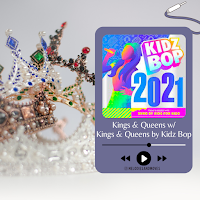
Kings and Queens Dance with Kings and Queens by Kidz Bop
Dance:
Music:
Clap to the beat in the intro and start dancing at the verse (0:15).
Dance as is shown in this video, but add extra 8 beats of dancing in place after the king and queen walk down the middle so that the beginning of the dance lines up with the chorus (0:45).
Keep going through the dance as done before until the outro at (2:08), students will free dance in place until the end.
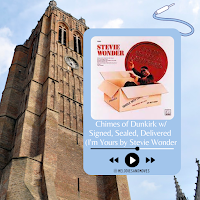
Chimes of Dunkirk Dance with Signed, Sealed, Delivered by Stevie Wonder
Dance:
Music:
This song is slower than the original instrumental music, but it also creates opportunity for moving with swagger and within the genre.
Students start moving at the start of the lyrics (0:09). When it’s time to sashay (0:31) 3 pairs of students will start to sashay or groove down Soul Train style every 8 beats.
Keep dancing as done before and the end of the song will finish as the 3rd pair sashays/grooves down.
🎶In the End🎶
When I first added pop songs to my folk dances I had no idea the positive ripple effect it would have, not only for my students’ sense of belonging but also as it related to my childhood experience. I can say I am the teacher that I wish I could have had; answering the question I had and my student asked, “How come the music that we hear in music class is different from what we hear outside music class?” And it all started with a pop song. As a first-generation Filipino-American and military child, Melissa Fuller Flores grew up showcasing Filipino folk dances on Air Force bases. The foundations of how to move to music primed and prepared her for a Bachelor’s in music education at the University of Alabama, and a Master’s in clarinet performance at the University of North Texas. Though it was difficult to leave her students in Houston after 6 years, Melissa currently teaches in just outside of Iowa City, Iowa. There, she continues to provide students with musical experiences that cultivate self-expression and help them thrive as positive, productive, and culturally mindful world citizens. When she isn’t teaching, Melissa enjoys presenting, creating, cooking, and being a couch potato watching her favorite shows.
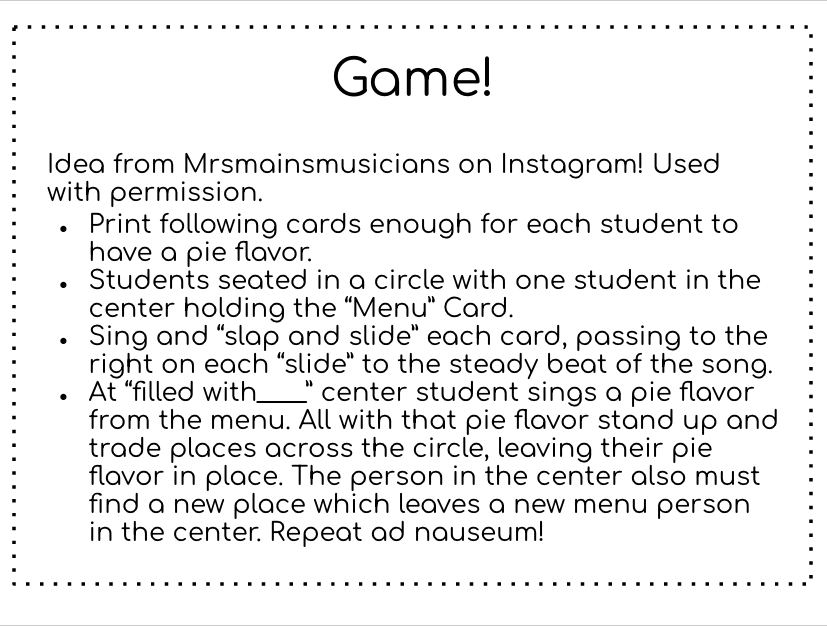
I love this song at this time of year as there is SO much that can be done with it- add an ostinato with pie flavors, perform the dance, talk about dance styles, create a new dance, student created B Section, and a game from the wonderful Mrsmainsmusicians on insta!
Grab the full google slides here. Please note this will force a copy.
For the game, I glued my pies to paper plates. This helps them to slide easier as most inexpensive paper plates have a wax coating on them. This also makes them round and pie shaped!
Hello, friends - first, an exciting announcement! I have a new community full of music educators who are trying to simplify their planning and grow professionally. I welcome you to come join for exclusive video lessons, activities, organization ideas, children's literature lessons, workshops, and one on one mentoring opportunities. We are going to have so much fun learning and growing with each other!
Diwali is coming soon- November 4. Diwali (orDeepavali as it’s sometimes called) means “row of lights” in Sanskrit. During this festival, people decorate their homes with lights and oil lamps, calleddiyas. The lights and lamps are said to help the Hindu goddess of wealth, Lakshmi, find her way into peoples’ homes, bringing prosperity in the year to come. It is also a celebration of good triumphing evil.Diwali is areligious holiday and festival originating in India. People often think of Diwali as a Hindu festival, but it is also celebrated by Sikhs and Jains. The celebration lasts for five days and marks the start of the Hindu New Year. The exact dates change each year and are determined by the position of the moon but usually fall between October and November.
Check out the Nat Geo page for more interesting facts.
Last year was the first year I incorporated Diwali more fully. I began by talking with some of my families who are Indian. I had some wonderful moms come in and teach me some Dandiya (stick) dances and we created a very simple one for our young students. There is some footwork involved in Dandiya dances but we focus more on performing with the sticks. I also talked with a few of my students who are Indian privately, asking if they wanted to speak or tell us during class about how they celebrated, or if any of them were performing classical Indian dance or song (I have a first grader who takes classical Indian singing lessons!) and invited them to perform.
Book to Begin
This is a lovely book and a perfect introduction to the customs and celebrations. This year I am recording two sisters who are Indian reading the book to show to all my classes.
Diwali, Diwali Song
Then we learned Manju Durairaj's Diwali, Diwali song and sang the chorus together.
Dandiya (Stick) Dance
We created a simple Dandiya dance on the chorus of the song. All movements are to the beat. Facing a partner tap right sticks together, tap left sticks together, tap own sticks to the right, tap own sticks to the left. Step back with one foot and tap sticks behind back, step same foot forward and both stick face right (like windshield wipers) and tap both partners sticks making a # hashtag, then trade places while turning around in a circle. Of course this can be modified but this is what the Moms at school and I came up with.
I would highly recommend wooden sticks - aluminum ones are available from Amazon but my experience is they break far too easily. Rhythm Sticks or dowels could also be used as long as they are the longer ones (12" or so).
Here is a video of Dandiya Dancing.
And an excellent teaching video to show you the footwork and sticking. The first one is just right for beginners and children.
Concert with Indian Instruments, Songs
This is an excellent 30 minute concert made for children from Lincoln Center featuring Grammy nominated artist Falu. I like beginning at 7:47 and end at 15:00 if I am pressed for time as they talk about traditional solfege, then Indian solfege, then sing a song incorporating the solfege.
Sitar and Tabla - played by KIDS!
A fun little video about sitar made for children:
Garba Dancing
My students love to see both the women and the men dancing here - and they love the music!
More Books Featuring India and Indian Characters
The Many Colors of Harpreet Singh - this is a google slide presentation featuring a video of the book, rhythms created from colors, along with discussion points for students about tone color. The end features several Bhangra dance videos.
The Wheels on the Tuk Tuk is sung to the tune of The Wheels on the Bus and is a great introduction to India.
Festival of Colors is just one of the most beautiful books and is about the Indian festival of Holi.
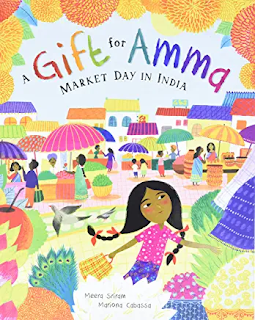
A Gift for Amma follows a girl as she goes through the vibrant rainbow colors of the market trying to find a gift for her mother.
10 Gulab Jamuns is the story of two brothers discovering a sweet treat from India.
Hope you enjoy all of these and Happy Diwali (in November)!
One of the wonderful things about social media is finding wonderfully inclusive children's literature. JoJos Book Club is one of my favorite pages on instagram. I appreciate the honest and straightforward reviews and have found some really beautiful inclusive books there. A couple days ago I found The Ocean Calls which is very new- just published in August 2020. Written by Asian American Tino Cho and illustrated by Asian Canadian Jess Snow this is a beautifully told and illustrated story of a South Korean island community of haenyeo - deep-sea divers. Grandma and her fellow divers, all older women, dive without oxygen deep into the ocean to gather abalone, sea urchins, and other treasures. Granddaughter Dayeon wants to be a haenyeo like her "treasure hunting Grandma" but she’s scared. Grandma shows patience as she listens then says, “Can’t you hear what the waves are saying? They’re calling to us to come home.”
The book can be used as a jumping off point to connect culture in so many ways.