This time of year I often need a few filler activities as classes that would normally have 18 students shows up with 6 due to illness, field trips or parties where students leave after the event and such. I have a few simple games that are great filler activities but still allow for singing and community building. This is one I wrote this year after observing a classroom teacher play the game and the students begin chanting, "Run, turkey, run!" while passing the objects around.
Hope you find it useful!
Game
One each of printed image of farmer and turkey. Cut out, laminate, etc.
Teach song.
Players sit in circle. Sing song, pass turkey as quickly as possible from player to player. After a few players have passed, begin passing farmer to try to catch the turkey.
Teacher can say, “reverse”, or “freeze” (or have a sound cue for each action) and students respond.
In the United States, the song literature we use in elementary music education is rooted in folk songs. As we grow as a culture and deepen our sensitivity and understandings of our past history, we learn things about our culture that are problematic and offensive. Some of our songs have histories with inappropriate themes and others have racist overtones, mocking or degrading various cultures, particularly Black or African American culture. Just recently a music teacher friend learned that the folk song, "Jump Jim Joe" was racist. The New England Dancing Masters changed the title of their book, "Jump Jim Joe", to "Rise, Sally, Rise" acknowledging the sensitive and negative history of the song. Although the one song is problematic, the remainder of the collection is a treasure trove of children's song material. It is available here.
By now you may have heard that "Ring Around the Rosie" is a song about the Black Plague. That is FALSE and urban legend according to historians. The plague began in 1347 and the earliest print appearance of “Ring Around the Rosie” did not occur until 1881 when Kate Greenaway’sMother Goose or The Old Nursery Rhymes was published. What you may not know is that that "Sing a Song of Sixpence" is about piracy, and that "Lucy Locket" is about the prostitute Kitty Fisher. Back in the day, Locket was a euphemism for a particular female body part. Check out the full story, along with how Casanova plays into the story here. Is your mouth hanging open yet?
Mine was. Though many of these songs appear innocent at first glance, as the lyrics have been "whitewashed", I cannot "unlearn" the offensive and often racist histories behind these problematic songs. Below is an incomplete list - incomplete because the more we learn, the more we understand and uncover. The truth behind much of our song history has been whitewashed, in the most literal sense, and so this list will be continually updated and added to. I must add that, although sources are listed, if a link is broken please understand it is not only my responsibility to read and research and do the work. We are all capable of researching and questioning song material. Do the work, question songs, engage others in doing the work with you and check out Making Good Choices from a NAFME webinar. We are stronger together.
"Black Joke" AKA "Hey Ho, Diddly Dum" original lyrics were vulgar and referenced sexual intercourse and female genitalia. Read more from the Traditional Tune Archive here. Original sheet music from the American Antiquarian Society.
"The Boatman's Dance" was originally titled“De Boatman’s Dance". It was performed in minstrel shows and mocked the speech of enslaved people. Read more from Song of America Project.
"The Cat Came Back" was originally titled, "“The Cat Came Back: A N...r Absurdity”. The lyrics mocked the speech of enslaved people and was sung in minstrel shows. See the original sheet music from the National Library.
"Camptown Races" is a minstrel show which mocked the speech of enslaved people. Read more here.
"Chicken on a Fencepost" AKA "Can't Dance Josey" the original lyrics contain racial slurs and theme of African American death. Original recording was on Holy Names University Folk Song Database and accessible until November 2019 when Holy Names was informed of racist lyrics and removed recording and sheet music. Library of Congress has the original recording.
"Coffee Grows on White Oak Trees" AKA "Four in the Middle" is a variant of "Can't Dance Josey" (See above).
"Cotton Eyed Joe" "Dinah" is a code word for an enslaved woman and contains a shortened racial slur. This song was used in minstrel shows. Original lyrics from On the Trail of Negro Folk Songs by Dorothy Scarborough. More information on use of "Dinah" from Collectors Weekly.
"Cumberland Gap" has derogatory terms for African Americans, "killing" of Indigenous people, "Hell", war, and "Dinah" (see Cotton Eyed Joe"), from American Ballads and Folk Songs, John A. Lomax and Alan Lomax, pages 346-347.
"Do Your Ears Hang Low" derived from "Turkey in the Straw" which was used in minstrel shows, see NPR Code Switch article. Also see "The Ice Cream Truck Song", "Turkey in the Straw", and "Zip a Dee Doo Da" below.
"Eenie Meenie Miney Mo" US variant uses racial slur. Oxford Dictionary of Nursery Rhymes shows the roots are probably Scottish or Irish where the "n word" was unknown in any English traditional rhyme or proverb. First recorded in New York City in 1815 as: Hana, man, mona, mike; Barcelona, bona, strike; Hare, ware, frown, vanac; Harrico, warico, we wo, wac
"Epo i tai tai" is often listed erroneously as "Hawaiian". From the Maori Indigenous people of New Zealand. In personal communication, the Maori Cultural Center was clear that this was not a song for children as it references male genitalia, bull testicles, and the virility of male warriors.
"Five Little Monkeys" was originally about enslaved people, one who was sick and the other one dead. "Shortnin' Bread" is the chorus of "Five Little Monkeys". "Monkeys" was a sanitized yet veiled epithet in reference to African Americans. Read the full story from Pancojams here.
"Hey Ya Na" AKA "Apache Melody" cannot be verified as being authentic.
"The Ice Cream Truck Song" is associated with a song called "N...r Love a Watermelon". See NPR Code Switch article. Also see "Do Your Ears Hang Low", "Turkey in the Straw", and "Zip a Dee Doo Dah."
"Jimmy Crack Corn" AKA "Blue Tail Fly" is about an enslaved person whose master has died. Many historians believe the enslaved person is rejoicing in his master's death.
"John Kanaka" was sung by English speaking sailors who had difficulty speaking the names of their fellow Hawaiian sailors. The Hawaiian name "Kanaka," means "Hawaiian Man" and became a stereotypical name for any Hawaiian person.
"Jump Jim Joe" began as the song, "Jump Jim Crow". From Wikepedia, '"Jump Jim Crow" or "Jim Crow" is a song and dance from 1828 that was done in blackface by white minstrel performer Thomas Dartmouth (T. D.) ... As a result of Rice's fame, the term Jim Crow had become a pejorative meaning African American by 1838 and from this the laws of racial segregation became known as Jim Crow laws.'
"Jim Along Josie" is a song that began as a blackface minstrel song in which African Americans and enslaved people are mocked and demoralized. Read more at Decolonizing the Music Room.
"Oh Susanna" contains racial slurs and theme of murder. The lyrics mock enslaved peoples speech. It was originally sung in minstrel shows. Read more from U. S. History Scene here.
"Old Dan Tucker" was sung in minstrel shows and the lyrics mock the speech of enslaved people. Read more from Pancojams.
"Pick a Bale of Cotton" pokes fun at the conditions enslaved people endured. A bale of cotton weighed about 500 pounds. An average man picked about 200 pounds a day working sun up to sun down (and often beyond). It was not humanly possible to pick a bale in a day and therefore mocked enslaved people. The song also contains the "n" word as has been referenced previously. There is some thought that the song may not have been a work song at all but a song created at the time of minstrel shows as there is no documentation of it before the 1930's. Read The REAL History Of The Song "Pick A Bale Of Cotton" (Partial Time Line From the 1930s to 1979) from Pancojams.
"Run, Children, Run" had an original title of "Run N...r Run".
"Shoo Fly" was almost certainly used in minstrel shows and contains language which mocks enslaved people. Original sheet music from the Duke University Libraries Digital Collection.
"Tie Me Kangaroo Down" is an Australian song, the original lyrics include a racial slur against Aboriginal Australians.
"Turkey in the Straw" was used in minstrel shows. Possible root was minstrel song "Zip Coon", see Ferris State University's Jim Crow Museum of Racist Memorabilia article, "Old Zip Coon/Turkey in the Straw." Original sheet music from New York Public Library Digital Collections shows stereotype image of African Americans on cover. See also "Do Your Ears Hang Low" and "Zip a Dee Doo Dah."
"Zip a Dee Doo Dah" -derived from "Turkey in the Straw", same tune as "Zip Coon", sung in minstrel shows, the chorus of which is "O zip a duden duden duden zip a duden day." See NPR Code Switch article. See also "Turkey in the Straw", "The Ice Cream Song", and "Do Your Ears Hang Low."
Some of these songs came from minstrel shows, in which performers appeared in blackface makeup. Folkloreforum has this to say about the minstrel show; The minstrel show was popular even before the Civil War, performed before audiences in both the North and the South. However, the shows’ materials changed once freedom was granted to the Negro slaves in the United States. Before the matter of freed slaves became a volatile issue, the typical minstrel show exhibited white men in black makeup performing song and dance exaggerated by lack of coordination and improper English, a style that became known as Jim Crow. After the Civil War, the stage opened itself up to new performers, recently freed slaves, willing to impersonate the impersonator. These performers, though already darker skinned, adhered to the minstrelsy tradition of blackface makeup. The tone of these black caricatures became less innocent and more damaging to blacks. Read the full Folklore Forum article, “Ten Little N...s”: The Making of a Black Man’s Consciousness by Tiffany M. B. Anderson, The Ohio State University.
What Now?
As music teachers, we control the narrative of musical culture and history for most of our students. We need to be aware of what we are supporting, perpetuating, and celebrating. Prejudices, stereotypes, and biases can be subtle and unclear. For me, I cannot use songs that have brought pain and humiliation, or devalue people. I cannot use the melodies and alter the words, either, as the melody has meaning and will be associated with the lyrics. Imagine standing in front of attendees at a POC Conference and "celebrating" by humming Dixie or Pick a Bale of Cotton. How would that be received? These songs are recognizable for what they inherently communicate. Our personal ethics and integrity is at stake - knowing music contains racist, biased, hurtful words that mock, belittle, and ridicule people based on skin tone, culture, or ability I am bound by morals and ethics wherein I cannot use this music in the elementary music classroom. I cannot "unhear" or "unlearn" the history, racist, and mocking information. We can choose to ignore, but that is the root of ignorance. NO melody is that perfect or irreplaceable.
If we are committed to including ALL of our students and fighting systemic racism, we have to be prepared to let go of these songs that have the power to exclude and choose song material that is inclusive of every child and their families. We are so fortunate to have such a variety of song literature - there are so many high quality songs that do not perpetuate stereotypes or racism. Problematic songs have their place; studied at a time when children are developmentally ready. For me, that is not with my 4-11 year old children. The choices we make matter, not only to us as individuals and educators, but also to our students sense of self and identity. The potential impact, not our intentions, guide us in deciding the choice to use a song and if so, how much information to share. If using a song may offend, or has the potential to do so, then we should reconsider our choices. Continue to research, the more we learn, the more informed choices we can make.
It is funny, the day after Halloween we suddenly transform our wicked witches and leering Jack-o'-Lanterns into stalks of corn and plain ol' pumpkins in preparation for Thanksgiving.
This song is a definite favorite in my room and I have seen other teachers who play the game slightly differently, but this is our favorite way to play it!
If you are looking for a place to hear a "real live" turkey, click here and scroll down to "gobbling". It made me giggle, and your kiddos will, too!
If you would like the pdf, please email me at musicquilt@Hotmail.com and I will happily send it your way.
Looking for other fun things for fall? Check out Pass Me the Turkey with a fun cup composition game!
Happy November!
If you haven't caught my LIVE on facebook yet, go check out all the past videos at https://www.facebook.com/ofortunaorff
Today I talked turkey. Yes, you read that right. I shared several of my favorites, many from my Sing a Song, Play a Game book and here are some pictures from the google slide you can get HERE. Please note this will force you to create a copy. :)
Last year I posted about the rhyme, Mabel, Mabel and using this to play with meters of 2/4, 6/8, and 5/4 - which is SO much fun and a good challenge for older students!
Click on the first picture for the original post:
Lastly, Pass Me the Turkey is a fun song with a CUP GAME! Check it out by clicking on the first picture to go to the original post.
Happy Thanksgiving! I am so thankful to all of you who have been reading and following along- we are almost at 1.5 MILLION VIEWS!!! I can't believe it! Who knew 12 years ago that I would still be blogging and publishing, editing, presenting, etc. Certainly not me. Be open to all the world offers, friends. You never know where life is going to take you. Blessings!
This is a fun game I watched during a morning meeting last year when I was visiting a Kindergarten class. I loved it so much I had to create a song for us to sing to go with the game! This would work well with the children's book, Run Turkey Run! This is also a good one for prepping half note (see measure 4 of the song).
Usually I don't post 2 days in a row but this was too good to pass up sharing and it is time sensitive in light of Thanksgiving next week.
I was on the AOSA Facebook page earlier this week and, as always, found wonderful teaching material, tips, and discussions going on. If you haven't been on the site lately, GO!! You will find so many wonderful ideas and if you are looking for a piece of music or need help with recorder, children singing in parts, or anything related to teaching music, you can ask and get various responses within a few hours. Truly invaluable and I have learned so much from the thousands of years of teaching experience there! There are other music teacher facebook pages, Elementary Music Teachers, I'm a General Music Teacher, Orff and Kodaly Teachers, and many others.. spend some time there - you'll be glad you did.
While I was on a page recently, a lovely teacher named Sarah shared a piece she had written earlier this week. I reached out to her and she so very kindly allowed me to share it with you!
The quack sticks are available from West Music here. They are about $5.00 each and kids LOOOOVE them! So much fun! Starting the second week in November, I greet kids at the door and play them as they come in; sure to get giggles and a nice way to start off class; students that behave nicely get to play it on their way out. Yes, dangle the carrot!!
They look like this:
This one I found yesterday on the AOSA (American Orff Schulwerk Association) Music Teacher Facebook page. MANY thanks to composers Trilby Jordan and F. Thomas Simpson for sharing and allowing me to share here! I LOVE this song and added a cup game composition using word chains of disliked Thanksgiving foods. Students performed them for their teachers when they came to pick up the class. LOVED it! Definitely going into my "keep" file for years to come!
This is a really fun song I found recently on Pinterest and happens to be composed by one of my favorites, Grace Nash, and another composer, Janice Ripley. My focus today was really to work on steady beat as my third graders are rushing everything like MAD and so this was the perfect lesson for their music classes today. I opted to use only the Bass Xy and Glockenspiel part instead of the full orchestration; for my purposes it worked beautifully and we had a hilarious time squawking and gobbling!
Here are the slides I put together with it for students. It was really fun!
Just a quick post today to re-post a fabulous song composed by a friend that is perfect for this time of year. HILARIOUS! This is a favorite with my kiddos!
It's called "Pass Me the Turkey" and has a cup game composition project to go with it! Enjoy!
The original post is here and has the music and the activity. Here is another one composed by another friend that is perfect for Thanksgiving!
Happy Fall!
I love the book Leaf Man by Lois Ehlert. Available from Amazon here.
Wonderful text and beautiful illustrations. I have used it many ways, including a simple lesson using "Rustle of Spring" by Sinding. The music is here.
I was browsing around today and what to my wondering eyes did appear but another beautiful lesson using this book by the fabulous Marjie Van Gunten! It is available here from Teaching With Orff blog. Go!! Seriously.. wonderful lesson!!!! Oh. wait.. more..
I have used the book with this lesson:
·Assign small groups
of students parts in the book (there are 12 parts, divide accordingly):Chickens, ducks and geese, pumpkins and
winter squash, turkey, cabbages, meadows, cows, breeze, river, butterflies
going south, birds.
·Give each student a
small handful of fall colored square pieces of construction paper (or faux leaves from Dollar Tree). Demonstrate
how they will throw them in the air on their special part (cabbage, chickens,
etc.). Once their pieces are on the floor, they create a shape that shows how leaves look. Spiky, curled at the edges, in a line, curve, etc.
·Play “Rustle of
Spring” by Sinding while reading and dramatizing
Black History Month.
Those three words have power, value, and emotion. Though the story of Black History Month began in 1915, it was not officially recognized until 1976 when President Gerald Ford officially recognized Black History Month, calling upon Americans to “seize the opportunity to honor the too-often neglected accomplishments of black Americans in every area of endeavor throughout our history.” Want to read more? Check this out.
.Black History Month is a special "pause" in our year to reflect and celebrate the vast musical contributions of Black and/or African Americans, but it should not be the only time our students see themselves represented and reflected in the music we use in our classrooms.
Things to Consider
Where is my focus? Who and what am I celebrating and honoring? Personally, I do not want to be the white teacher telling a single narrative about Black and/or African Americans as slaves and that they are only worthy of celebrating when talking about slavery or the Civil Rights Movement. How does this impact our students view of musicians and composers who are Black and/or African American?
Sing, listen, and teach about music from a broad perspective; spirituals and Civil Rights songs are valuable, but they are not the only music to be celebrated and learned.
If we teach these songs we should keep our community and parents informed of our intention to teach about slavery. I have known many music teachers who begin to go down this path and receive emails and phone calls from upset parents who have not discussed slavery with their child and now they are forced into a conversation they were unprepared to have.
For me, I want my students to celebrate, honor and learn about Duke Ellington, BB King, Billie Holiday, Scott Joplin, Ella Fitzgerald, Leontyne Price, and Miles Davis. I also want them to celebrate, honor, and learn about Jimi Hendrix, Stevie Wonder, Nina Simone, Queen Latifah, Tina Turner, Alicia Keys, John Legend, Denyce Graves, Black Violin, Rihanna, The String Queens, will.i.am, Ne-Yo, Rhiannon Giddens, and Ranky Tanky, (who just won a Grammy and are amazing - listen to this podcast and you'll see why I love them for elementary aged students).
Sister Rosetta Tharpe - do you know her name? I didn't until this past year. Learning about her was eye-opening and a bit shocking- how did I NOT know her name until now? She was a pioneer and laid the foundations for Rock 'n Roll. Read more about her here from NPR.
Here are some of the things my students and I will be using throughout the year, not only during the month of February.
Children's Literature
Rap a Tap Tap: Here's Bojangles - Think of That
Change repetitive words to "Rap, Tap, Tap, Think of That". (3 quarter notes, 1 quarter rest, repeat same rhythm).
I use this with Kindergarten students after we first do some movement preparation to "Superstition" by Stevie Wonder.
1. Read Book, encourage students to speak repetitive words, "Rap, tap, tap, think of that".
3. Videos - Tap Dancing Group - I like this one - you will only watch until 1:20.
Next I show Savion Glover - this is such a cool commercial- just skip the end (commercial for a fridge).
How to Tap- this is really good for my younger kiddos - very slow, sequential. We only watch to about 3:00 and we stand up and practice tapping.
4. Then I break out the Heart Chart and we go back to the book of Bojangles - the Heart Chart is amazing and many music teachers have them or something like them - it is the perfect way to introduce quarter and eighth notes. Once we have explored, ""Rap, tap, tap, think of that" and learned how to clap it, etc. and have discovered quarter notes, we tap it on rhythm sticks. That leads into eighth notes, and before we know it we are reading stick rhythms with quarter and eighth notes.
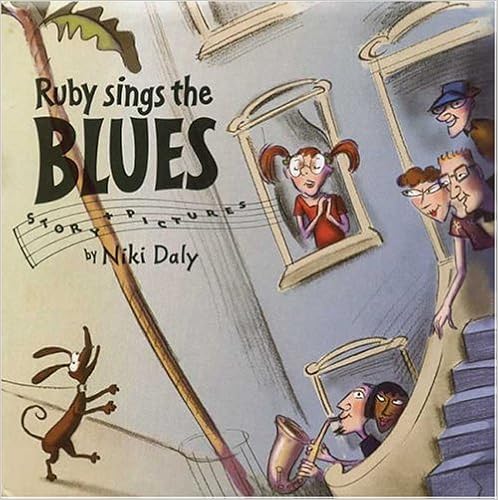
Ruby Sings the Blues
I love the animated video here with jazz music in the background. It is really well done!
Trombone Shorty
Great lesson to go with this from my friend Charissa! Check it out here.


 Enjoy!