Showing posts with label why teach music. Show all posts

Sunday, October 13, 2024

So You Think You Want to Be a Clinician/Presenter...

This post came out of a discussion with my dear friend, Roger Sams (co-author of Purposeful Pathways) and several experienced clinicians and presenters. We have noticed several trends with newer music educators who want to be Clinicians and Presenters and want to help others and offer some free and unsolicited advice. 


 "Being an awesome music teacher is the opposite of being a rock star. A rock star wants the focus on them. An exemplary teacher always puts the focus on the learners. If you're still imitating others, taking their catch phrases and using them as your own, using titles or names that are already being used and claiming them as your own, quoting people, but not citing them, etc. you're still in the imitation phase. There's nothing wrong with being in the imitation phase, that's where we all begin, but you're not an expert yet." -Roger Sams 

Intention 
Enter into the era of presenting or being a clinician out of a SERVANT heart - a desire to center the learner, giving back of yourself and sharing the knowledge others have so willingly and often sacrificially given. Choose to lift others up and acknowledge the shoulders upon which you stand. Climbing any ladder while stepping on the hands that helped you is unprofessional, unethical, and will leave you feeling empty and unfulfilled. Check your intentions (and spend some serious reflection time) and ask yourself if you have truly moved beyond imitation into expert mode.  This often takes many years to happen.

Ethics and Morals 
Share what comes directly from your own experiences with teaching in the classroom. Consider that the majority of what you share should be your own material (and not just 60%- about 90%). Acknowledge others (even when it is simply, "inspired by a lesson as learned from ____"), cite sources correctly and in writing, ask permission before sharing something learned from someone else (and if they say no, that means NO), put the permission in writing (not a verbal acknowledgment), center others, and apologize when you make mistakes (and you will; I still do). Don't post other people's lessons on social media without permission or change one small thing and then share as your own. When sharing a song or lesson, make sure what you are sharing doesn't belong to someone else (it isn't always "folk" and/or in public domain). Share the full lesson - not a teaser page that acts as clickbait for teachers to feel pressured to make a purchase or as an advertisement for a TpT purchase. Content over cuteness and sharing over selling. Remember the sharing that happened during Covid lockdown? It is one of the things that makes our community of music teachers so very special and didn't happen in other education disciplines.

Value 
The value in sharing of yourself is that YOU are a unique and experienced music teacher with ideas that will help others be better at their craft and enrich their students musical education. Presenting at a workshop will not make you rich. Most teachers make about $600.00 per workshop. That might sound enticing but here's the breakdown: 
Notes and Slides Presentation: Between 4-10 hours preparing presentation notes, music scores, creating graphics, notes for participants, slides, Keynotes, Powerpoints, etc. 
Travel: Depends on location; just last weekend I spent over 24 hours in cars, ubers, and airports and airplanes traveling to Canada to present. 
Presentation Day: Arrive 45 minutes to 1 hour early to workshop site, 4-hour workshop, cleanup 30 minutes, lunch with the chapter board for 2 hours. This doesn't include the emails, texts, and additional time to work with the Chapters to contract, go over details, instrument needs, etc. 
Time: Between 36 and 42 hours, which doesn't include the full time away from home. That is $14.29/hour. to $16.67/hour.  And then you pay taxes on that. I sacrifice time with my family, my students, and even myself sometimes, but I believe strongly in serving and sharing. It isn't about me - it IS about the learners in the room - be they children or adults. 

Joy 
It is joyful to see the lightbulbs on teachers faces when, in the middle of a workshop, they see an idea forming or have a beautiful and emotional response to something they have just learned to do differently, more purposefully, and more joyfully. THIS is why we present - to share of ourselves fully by serving others. We do it with joy, with love, and with grace, hoping that we can help make a difference in a teachers' life, and ultimately, through them, with their students. 

Please don't be a rock star - be the beautiful, wholesome person you are who teaches and shares from a place of expertise, joy, creativity, and love.


Tuesday, December 27, 2022

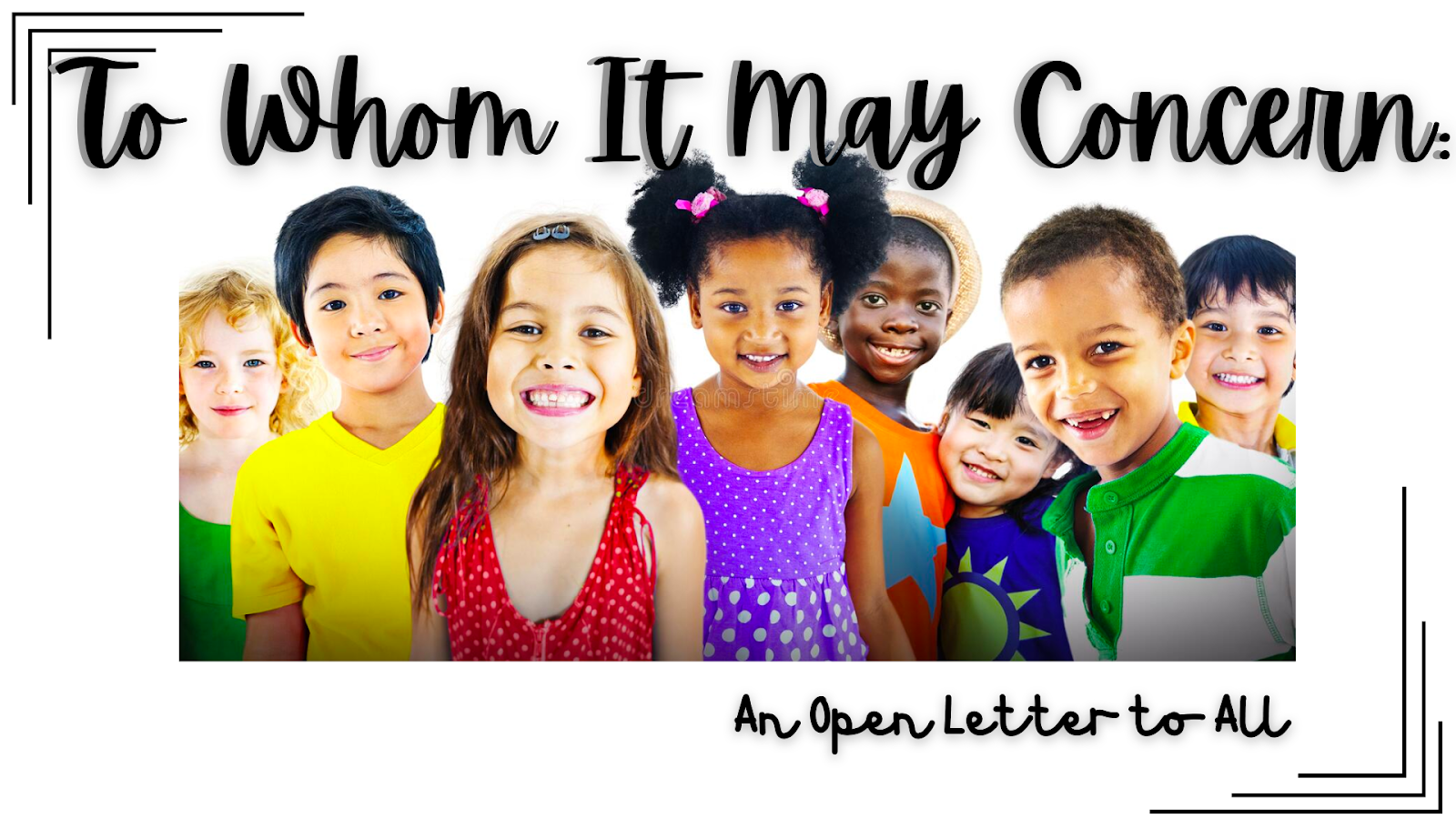
To Whom It May Concern: An Open Letter to All


The ending of a year is a contemplative time for me.  Thinking about the past year leads to thoughts of what I want to change and improve upon in the coming year. This is a letter I have wanted to write for a while and one which I wish someone would have shared with my first year teacher self and continue to share with other music educators. I hope it encourages you.

To Whom It May Concern:

I don't teach music. I teach children music. There is a big difference in what and who is centered in those two sentences.

Teaching music begins not with the teaching of music concepts and skills, but with focusing on WHO we teach. Children first. That means that for most of us who teach elementary music, there is a steep learning curve in understanding the wide range of developmental ages and stages we teach. In a single classroom, we have at least five, and often MANY more various stages of typical childhood development.  Add to that neurodivergence, medical and cognitive differences, social and emotional variances, and cultural and personality differences and there is much to be learned.  

We have a responsibility as music teachers who teach a high quality music curriculum; a responsibility that allows all students to experience music from people around the world without bias. High quality music should not include music that is problematic, questionable, or racist. Do your research and don't rely on others to do it for you. Google is free and available for all.  Music history, musicians, and music created by various identities, religions, and genders will be used in our classrooms.  Identity formation is a critical aspect of social development in children as they develop sense of self, understanding, belonging, and acceptance.  The idea that classroom curriculum should serve as "windows and mirrors" for children has been around for over 30 years - first coined by educator Emily Styles in 1988. Approaching children's music and music education through the lens of windows, mirrors, and sliding glass doors prioritizes diversity, honors cultural experiences, and promotes empathy and understanding.  It also helps all children to feel included and a part OF, not apart from, as they see themselves in the music and musical experiences.

Our greatest responsibility is not in data collection, meetings, trainings, and PD's that are unnecessary, irrelevant, or do not promote the advancement of our craft and art. Our greatest responsibility is to help each child become the best version of themselves which means everything we do should be steeped in doing what is best for children, not adults.  Children are at their best when they feel seen and loved. It isn't always easy to love and even like every child and the "prickly pears" and "frequent fliers" can be downright difficult.  It isn't always easy to connect and be relational with every child. The reality is we sometimes struggle to find just one way to connect with a child. But to that child who finally feels seen it means the world.  Find the one thing.

There are many outside forces demanding teachers time, talents, and energy.  Music teachers don't stop being musicians or music teachers at 3:45 when they are "off the clock."  Music teachers often teach private lessons or have secondary jobs directing ensembles or playing or singing in adult music ensembles.  We often listen to music passively while wondering how to create a lesson to go with it. We have families and lives outside of school.  Boundaries are necessary - hold to them and live your life.  Stop comparing yourself to others and start advocating for yourself. Period.  Do the next best thing for you. 

Finally, be kind. To yourself, your fellow teachers, to your students, and to strangers.  A kind word or gesture goes a long way in this filtered world where "likes" and "followers" dominate. 

With much affection, 


Thursday, August 25, 2022

Words of Experience

 Well, I had hoped to not get in the weeds of life and post almost every day since my last post but that didn't work out! 😂 Oh well.. best laid plans!  

Here is the rest of the advice I had hoped to post - see previous post for the first two. 


Happy new school year! 


Saturday, August 13, 2022

New School Year Words of Experience

 I was about to write, "words of wisdom" in the post title, but I don't feel that is correct as I am certainly not wise, simply experienced. 

So, for the next several days I will be offering some advice from 29 years of teaching. Hope you enjoy! 

Be sure to be looking on facebook as my "Live" broadcasts will be starting next Tuesday at 7:00 AM EST and every Tuesday thereafter. These are all recorded and available on the O For Tuna page so if you aren't awake or available at 7:00 EST, you can always go check them out - there are already SO many from the past couple years of videos where I share songs, books, activities, and teacher ideas. 

So, onward we go! Welcome to the 2022-2023 school year! 


Friday, December 31, 2021

Behavior Reboot

 Behavior. Say that word to any teacher this school year and you will get a multitude of responses and emotions including hands thrown up in the air, eye rolls, shaken heads, and sighs of frustration, disappointment, and discouragement.

How many of us are feeling the effects of Covid in our classrooms? Every. Single. One of us. And it isn't their fault - it seems we pressed the "pause" button on child development in March of 2020. You have probably seen the meme about the last time our fourth graders had a normal school year - they were in FIRST grade. Our second graders have NEVER had a normal school year. Once back from Remote Learning students came back into schools that tried to make them sit in desks, work in groups, walk in lines, be present, focused, on task, be around other children, with or without masks, and expect no differences.  Our students have been impacted by all of this in ways we cannot possibly understand. We can understand what we understand, but we need to understand we will never truly understand. We are not children who have been through what our children have been through. 


Students who have never been in a school before. Students who don't know how to lock the door on the bathrooms because they have never been in a public restroom. Students who don't know how to line up, even after 3 months of being in school. Students who don't know how to be around other children or in large groups, or work in a small group. We have probably all seen or know someone who has seen students tearing things off walls, throwing chairs, running out of classrooms, screaming, arguing, or just falling apart.  

They are trying to tell us something. Maybe we need to


That means we have more opportunities to show consistent and positive kindness and love, to set consistent and positive boundaries, to figure out how to love on those "prickly" kids, and to help our students be their best selves. 


It also means to expect the unexpected.

With the winter break it is now time for a Behavior Reboot in 2022.

With each class:

  • Before the class even comes in - are YOU ready? Are your materials close at hand, do you have a backup plan in case the lesson goes sideways? Do you have some pocket songs or books nearby you can sing or read in case that is what the class needs?
  • Are YOU centered and focused? I find that closing the door before the children come in the room and taking a 30 second inventory - closing my eyes, taking 3 deep breaths, setting an intention of positivity, care, and kindness, helps me enormously to feel grounded. 
  • Are YOU prepared to meet the children where they are? If they come in hyped up on sugar are you ready to do the Seven Jumps dance (my next post will be on how I use this dance - it's not the traditional one) or something else to get the wiggles out?  This helps in leading them down the path to where we need for them to be. Doing so is purposeful yet playful, and encourages relational teaching and builds community.
    Enforcing immediate compliance without time to transition into your class is similar to a prison guard trying to re-establish control during a prison riot and can lead to you and the students being at odds.
  • Set clear expectations and boundaries. Then set them again. And again. KEEP those lines drawn. What I say is what I mean and what I mean is what I say. The consequence may be different for different children and that is OK- fair and equal are not the same.  Part of this is knowing your students and being relational. A child who is trying to get away with behavior is not the same as a child who is acting out of anger or frustration. A child with mental health challenges is not the same as a child who is sneaky and manipulative.
  • What is your lesson flow or structure? Children, like adults, thrive with routine and structure. That doesn't mean there is rigidity and inflexibility. Here are some ideas for the first 5 minutes of class. Here are some ideas for the last 5 minutes of class or for when you need an additional quick activity. 
  • When difficult behaviors happen, don't get in a power struggle. Just don't. It doesn't work for you OR the child.
  • Be the investigator - what does this student need? Do they need a chance to feel successful? Do they need to be a helper and turn lights on or off or get things for you in the classroom? Do they need a time out or a time in? Are they overstimulated - Do they need a quick trip to get a drink of water/go to the bathroom? Do they need a side hug or just to be told they are not in trouble or that you care about them? 
  • Remember we teach children. Say it with me. I teach children. I teach tiny humans. Then say, "I teach tiny humans music."  When teachers say, "I teach music" it takes out the human element. We teach music to children, but we teach children first.  
  • If what you are doing isn't working, put on the investigator/experimenter hat and try something different. Talk to classroom teachers to find out what is working for the class or specific children and try, try again. 
  • Also, it's important to say we as teachers are going through a lot. A LOT. A LOT A LOT A LOT. Take your mental health as important as you would a serious physical illness. Take a walk, do yoga, get a massage, cry, play piano, sing, journal, see a counselor, talk to someone, ask for a hug. DO the things you need to and don't feel you have fall on your sword as a teacher - you matter, your life matters, your health matters. Teaching is not more important than you. Prioritize your health and well being. 
Please know I'm always here for you.
Much affection, best always.


Friday, October 30, 2020

Checking In, Checking Up

 My daughter, Caiya, is about to turn 13.  With that is all the expected eye rolling, sarcasm dripping from the tongue, and the need for independence. She is an awesome kid- funny, incredibly artistic, and still loves hugs and talks with Mom. She loves to be around us (yay) and is very sweet and tender-hearted, all of which I am incredibly grateful for. Here is some of her amazing art: 


I chose this image my daughter drew below because I think many of us are feeling all the feelings - lonely, sad, angry, frustrated, discouraged, disappointed, and so on. I hear that - I see you.  


While my daughter was in hybrid mode this fall I was full-time with students at school. She would be home, in the craft room at her drawing desk online with classes. She is incredibly responsible and on top of things- well organized, and a good student. My husband works from home, and did pre-Pandemic, so nothing has really changed for him except that we have been underfoot. He would wander in occasionally to "check in" on Caiya. She saw it as Dad "checking up on" her. We had to talk about the importance of understanding there was CARE behind it, not accountability. 
So, how are YOU handling your CARE of yourself right now?  Are you taking walks, reading a non-PD book, indulging in Netflix and Prime, baking, making time for a hobby, and making some music for YOURSELF these days? Are you reaching out to friends and family and staying connected?  All of these things are not just important, but they are vital right now. 
Recently some beautiful music teacher friends got together to chat about our various situations - we were spread across the US - Michigan, Washington State, North Carolina, and Connecticut. Not one of us are teaching in the same situations - we all have various ways of doing and being but we all deeply love and miss our students and normal music making. Not one of us is teaching with the same schedule/mode/model this year.  I will be updating this post early next week and will share the link from my dear friend, Elizabeth of https://caldwellorganizedchaos.blogspot.com/.  
Please take CARE, my friends - there is only one you and YOU MATTER!


Sunday, August 4, 2019

Music Education - Blogs and Podcasts


I have one week left, although we only have three days in classrooms (most of that taken up with meetings) and students begin on Thursday, so next week I will be in my classroom, getting everything ready for another exciting year. Image result for teacher summer over meme

As we set sail on a new school year, many of us are in our first or second week of school and many others are preparing classrooms for students to enter in the next couple of weeks. Still others are on their final countdown of summer with their last few weeks spent swimming and adventuring.
This summer has been very different than my typical summer - school ended and the next day we left for 2 weeks in Maine, home a week, then my daughter and I went to NYC for a week, home a week and a half then I left for Estonia and the International Music Village, which was ESTonishing (Soili Perkio's word), just got home Monday and I will be in school tomorrow to get my room ready!  Not sure I like how little time I have had at home to do my usual re-organizing and relaxing. :)
Image result for summer reorganizing teacher meme
The best teaching ideas are often borrowed and adapted from others.  I have learned so much from watching, listening, and talking to other teachers.  There are so many excellent podcasts and blogs with ideas, activities, philosophical discussions, and information that is interesting and helpful! Thankfully, some teacher friends have organized and collated these into single sites that help us navigate and find the ones of most use!

Podcasts

Podcasts are usually free digital audio files, typically in a series, which can be downloaded and listened to at any time. They are a great way to engage with other's teaching perspectives, approaches, activities, lessons, and to get inspired.

 Evan Tobias recently published a HUGE list of podcasts both current and archived.  It is well organized and categorized.  He also provides a list of ways to listen to podcasts for newbies.
 Image of a massive list of music education and related podcasts

Blogs

1.  MusicEd Blogs is a collaborative site which includes almost 40 music education blogs in one place, organized and categorized.  Check out their facebook site as well, @MusicEd Blogs Community.  
2. There are many other music ed blogs, this is a list of the "Top 100" Music Ed Blogs, along with links.
3. David Row from Make Moments Matter also includes a well organized list of music education blogs here.


I hope you find some of these useful and look forward to sharing more lessons and activities as school gets under way! If you are not already following ofortuna on facebook - make sure to check it out as I post videos and extras there - @o for tuna orff schulwerk music and on instagram -@Aimee_ofortunaorff.
Happy 2019-2020 School Year!

Tuesday, July 17, 2018

Why Orff?

A recent post on Facebook asked, "Why Orff"?


They were not only asking why people choose or use Orff Schulwerk but also wanted to know why teachers identify as "Orff/Kodaly/Gordon/Dalcroze/Music Learning Theory/Feierabend" specialists.

Part One of this I wrote last year:  Check it out here. 

Find Your Tribe

“Call it a clan, call it a network, call it a tribe, call it a family: Whatever you call it, whoever you are, you need one.” — Jane Howard, Margaret Mead
I think it is basic human psychology to identify with a group of like-minded people.  When you find your "tribe", there is a sense of belonging, kinship, and sense of community.  Add in the language that is specific not only to teaching music, but the language of the approach or methodology and the kinship/community/friendship/ support/connection is powerful as we see not only how our students are impacted, but how we are impacted professionally and personally.  Some of my deepest and most impactful friendships are with other music teachers who live and teach in other states. We might only see each other once a year at the Orff National Conference.  These are my "go to" people; I highly respect them professionally and enjoy their impact not only on music education and the Orff community, but also value their friendship. The first moment I attended an Orff workshop I found "my tribe" and knew these were like minded, creative, artful, and artistic musicians.

 Orff Schulwerk

There are many common misconceptions I often hear -
"It is a methodology".  Nope- it is an active and creative approach to developing musical understandings in every learner through the integration and development of music, movement, speech, and drama.

"It's all about the instruments and I don't have any".  Nope!  At its core, teaching with the Orff Approach is based on the way children learn- through PLAY!  Students imitate, explore, improvise, and create as they grow and develop.  Students use their bodies, voices, and classroom instruments. The "Orff instruments" - pitched percussion instruments (glockenspiels, xylophones, and metallophones) are used to create accompaniments but are "nice, not necessary".

"Orff is focused on folk dancing."  Nope!  The Orff Approach focuses on student centered creativity, speech, singing, improvisation, creative movement and so much more!  I happen to love folk dancing, and it is a part of creative movement.  Folk dancing involves movement, provides opportunities for creative physical responses to music and acts a scaffold on which students can build expressive movement language.

"The focus is not on sight singing."  Right, and Wrong!  There is not a singular focus in Orff Schulwerk.  Elements of the Kodaly and Dalcroze methodologies are also a part of the Orff Schulwerk.  Personally, I think the Kodaly sequence of "prepare, present, practice" approach aligns beautifully with the "imitate, explore, improvise, and create" approach of Orff Schulwerk.   Students become artistic, expressive, and creative musicians who develop their personal musicality and expression. Many of us have come to embrace the quote, "Speak, sing, dance, and play in a tuneful, beatful, artistic way.". I love this!
So, what is Orff?  Here is a 2 minute video that does a great job explaining in a more visual and auditory way!

Want a little more?
Here is a little longer video (7 minutes) that shows a classroom in action.

Workshops vs. Levels Courses

Workshops are a great way to experience Orff, and just like any workshop, clinicians offer a variety of activities and experiences.  The subject areas are diverse.  Many of my workshops focus on hand clapping games, songs, and dances and children's literature, art and music activities.  If you are new to the Schulwerk, try going to at least four different workshops to experience the diversity of subjects and teaching styles.  For a list of chapter workshops that might be near you, check out the AOSA page. AOSA is the American Orff Schulwerk Association.

Levels Courses
Workshops give you a "taste" of the Schulwerk, but your taste buds haven't fully experienced the full array of flavors!  That is what Levels Courses are for!  These are certification courses held for two weeks throughout the summer in every region of the US.  There are 3 Levels, and a post-Level III, which used to be called "Master's Level". I would strongly recommend taking one level per summer and not trying to "double up" as you need time to let things "sink in" and time to apply your new experiences with your students.  Many local chapters also offer scholarships as does AOSA,  Here is a list from 2018.

Have more questions?
Drop me a note below.  Hope this was helpful!

Tuesday, May 29, 2018

The Top 5 Things I Would Tell My First Year Teacher Self

Reflection, self-awareness, consciousness, mindfulness.  We hear these words often, particularly within the educational realm.  Looking back upon my 24 years of teaching, what would I tell my first year teacher self? 

Teaching is a Marathon, Not a Sprint.

You don't have to do it all in one year, or in the first three, or first five years.  For most of us, we don't really "figure out" teaching; content, classroom management, protocols of school, student development, how to deal with those "frequent fliers", political/social/emotional context of school, etc. until about year four or five! 
Create/make/enjoy five lessons and activities that worked well the first year, add five more the next year. Within four years you will have TWENTY slam dunk lessons and activities.  But don't stop changing them - never feel like you are "done" with lessons - always change them to meet the students needs and whatever direction they choose or need to take them.

Get into Orff!

Find a local chapter and get involved in workshops and in the organization.  It will change your teaching and the students learning in a beautiful, musical, artful, creative, and wonder-filled way!  I didn't really know about Orff until year 6 of teaching!  Oh how I wish I had known about it earlier and gotten Levels courses earlier!  Open yourself to all the experiences - your teaching and your students will be drastically changed - for good!

Be Kind, Then Be Kinder.

Be kind to those teachers who call you "green", or treat you as inferior simply because you are new. You have value, ideas, and strengths to contribute. Be kind to those who come over to slam your door or complain because they placed you next to the reading teacher and she can hear your music. Be kind to the front office staff, the school secretary, cafeteria workers, bus drivers, and the janitors.Their jobs are hard and full of juggling and discouragement.  Be kind and then be kinder to students - they are little and someone loves them- yes, even the ones who frustrate and annoy you to beyond the world's end - they are someone's sweetheart, and sadly, if they are not, YOU need to find a way to love on them.

Love the Cactus Kids.

Prickly, sticky, mean, grumpy, dirty, matted, annoying, frustrating.  Describe any of your students?  These are the kids who need you the most- not the perfect singer or dancer, not the kid who can rap like crazy and throw down "beats". The ones who you know are not getting enough - food, shelter, hugs, warmth, affection, and yes, love. What the world needs now is love, sweet love - it's not just a song- it is the sad reason many school shootings have happened.  Find a way to make the outcast become part of, not apart from.  Love the unlovable and lead by example. You never know what seeds you are planting. A little kindness goes a long way.

It's OK, Just Breathe.


Your first year will be stressful - reach out to others for help and advice.  There will be very busy times and not so busy times - breathe and ask questions. There is a wonderful network of teachers who are wanting and waiting for you to ask questions.  I started teaching pre-internet (dinosaur era) and now teachers have access to thousands of years of experience via facebook and online groups for music teachers. I wish I had spent more time asking what I felt were "stupid questions".  Suck up your pride and ask.  Stay balanced with a healthy amount of school time and maintain your other "you" - continue to read historical fiction, make jewelry, go antiquing, take walks, perform, etc. Your identity as "music teacher" is not your only identity.


Thursday, July 6, 2017

How to Teach and Not Lose Your Mind


At times teaching music can be particularly overwhelming. Duh, you say. At times you may feel like that poor spud; coming apart at the seams. Oh YES, you say.
Like the beginning of the year when you have hundreds of children's names to learn, or the first concert of the year, or how to deal with all those IEP's or behavior plans.  Or holiday concerts; sacred versus secular, or how about recapturing their attention after the holiday break, or what about that one class that consistently misbehaves? And how to integrate technology in a meaningful way?   Time management, how do you balance it all?  Or how about keeping up with whatever new educational trend your leaders are encouraging/mandating?  Project Based Learning, technology integration, differentiation, relational teaching, integration, Maker Space activities, Assessment Models, Gamification, Flipped Classrooms, Autonomous Learning Model, Brain Based Education, and more! 

Which can lead us to all feeling like this:
 
See the horse on the top, yes, at times that is me.  Although with a bit more of bottom horse's eye roll and neck twist. 
Is your head feeling like an overfilled balloon? Is it going to explode or simply take off on a five year trip to Mars?  Deep breath.  Music teaching (without losing your mind), really filters down to two BIG ideas. PAB and Tightrope walking.  Yup, really.
PAB:  Plan, Anticipate, Be (Prepared).  I'll go over that in just a minute.  Let's get to the one you are scratching your head over first. 
Let me ask you, tightrope walkers, what do they do?  If you answered eat or drink nothing for an hour before a performance you are probably right, but we are not talking about that.  BALANCE!!  Read on...
 

1.  Plan, Anticipate, Be Prepared

Plan

Many successful, happy teachers will tell you it's all in the planning.  Organize and plan your scope and sequence for the year, anticipate the problem areas in the lessons, and be prepared to adjust. I know teachers who have a complete specific plan for the year, but snafus happen with snow days, field trips and those lovely, last-minute assemblies or pep rallies.  Hip hip hooray! 
What skills, concepts, and behaviors will be studied each month?  I have lists of songs along with musical elements and select ones that will work together.  At the beginning of each month, and then each week, I plan more specifically. This allows for adjustments to be made without throwing off (and out) the complete scope and skill sequence for the year.
Plan how you are going to organize your materials and files; everything digitally, a mix of digital and written, files organized by theme, grade level, month, etc.  Sometimes these evolve over time and there is no "One Size Fits All".  Everyone has their own system that works for them and sometimes they need BIG overhauls; plan for what works for your strengths and situation.
Plan to be involved in your school; frequency, length of time, etc. This is a BIG one folks; plan for balance between home and school.  Will you work an extra hour on that program after school in order to avoid bringing it home?  My rule is always "Family First".  My family, and my daughter who is in elementary school, come first before anything else, hard and fast rule and NO apologies about it.  Plan ahead to understand the IEP's or behavioral issues, plan for consequences when students misbehave, plan for the bad days; they will happen.  If your school follows a specific educational model, engages in a behavioral idea, or uses technology 1:1, plan for how YOU are going to use it in the music classroom. 

Anticipate

Anticipate not only the lesson (what might they struggle with) but for the time when your principal walks in with visitors and the superintendent and wants your "elevator speech" (quick 5-7 sentences, 1-2 minutes) about music education. Anticipate that there will be days when a parent might give you a dressing down in the hallway, or send you a nasty email about how you treated their child.  Anticipate that the copier might not be working today, or that the secretary forgot to order post-it notes, or that your paperwork request for _____ got lost.  Breathe, smile, force your face to relax (be mindful of wrinkles, dear), and move ahead.  The world will not end, I promise.

Be Prepared

As you anticipated, you also were probably thinking, "If that happened, I would do _____".  Be prepared to follow through on your plan of action, whatever it may be.  Be prepared when the classroom teacher is 5 minutes late picking up their class. Oh, that never happens?  Lucky you!  Here is a blog post about ideas and activities for just those times.
Be prepared when the classroom teacher drops them off and says, "Have fun singing!".  Instead of knee-jerking to let them know there is more to music than singing and going into a long explanation about Italian dominant 7th chords, say, "Thank you, we are going to be making some fabulous music, can you come back a minute or two before the end so the children can share with you?".
Make sure that your attitude is prepared also; "Choose your 'tude".  You have the power to make it a lousy day, and to crawl home feeling like a worm, or to have a little cry, pick yourself up, slap on some lip gloss, and sing "Let It Go" at fff!   
 
A friend once told me to think of teaching as a marathon:  The good stuff doesn't happen all at once. 
A moral of a race between a rabbit and a turtle:  Slow and steady wins the race.
Sometimes you just need to give it time.


2.  Balance

When I first started teaching I gave ALL my energy to the students. I quickly found I had no energy left for anything else. I still struggle with this as I really love what I do.  As my sister says, "Everything in moderation including moderation".   That is not to say I don't give my all every day, I do, just as there are moments I have to give 110%,.  But I also have had to learn to pace my energy levels for each class and not to jump/dance/move with the kids for every lesson when there are 6 classes all doing the same thing that day!  Although it is a fabulous workout and gets my workout out of the way, I just end up hot, sweaty, and tired by lunch!
I have taught for 24 years and in that time I have had some major life changes; cancer, 14 surgeries, moving from Maine to North Carolina, marriage, adopting from China, 6 more surgeries, knee issues, presenting at workshops and conferences, publishing my first and second books and now working on third and fourth.  Oh, and blogging.  All of these things were filled with many emotions and all of these were time consuming.  I didn't fall into a black hole in the sense they consumed my whole life, but I was able to have balance through most of these life events.
Teaching music is different from many other educational fields in that our jobs are often 24/7; music is pervasive. Whenever we go to a concert//listen to music/go shopping we are analyzing the music and looking to see if that ____ (book, bowl, ball, etc., fill in the blank) can be used in our classroom.  Most of us perform in an ensemble or as a soloist outside of school, and music is as much a part of our lives as breathing.
A teacher friend once said, "School is school and home is home".  Define in your mind where that line is drawn.  Try to NOT work on school outside of school.  I know... easier said than done. 
When I began this blog it was an extension of teaching music, but it's not school related. I happen to enjoy writing music and sharing lessons and ideas, so while it is music education related, it is not school related and it is something I enjoy greatly! This brings balance to my life.
I also exercise, hike, draw, sew, craft, bake, and ensure that my weekends and summers are not filled with school stuff; I have found I need summers and weekends "OFF".  That means while I enjoy children, I do not teach Sunday school at church or summer camps at my school.  I indulge in binge watching Orphan Black or Odd Mom Out, read books that are not about education, usually Dean Koontz or thrillers, travel, hike, watch movies, and enjoy my family. 
Find other things you enjoy and ways to become involved in those activities; recharge your batteries and leave some energy in reserve at the end of your teaching day so you can find your balance and be
.
Have a wonderful week!

Tuesday, November 22, 2016

Why I Teach Music Blog Hop Giveaway Winners!

Last week an amazing group of music teacher bloggers shared the things that motivate and inspire us as music teachers. We invited you to share your #whyiteachmusic stories as well. I was inspired by your responses and loved finding that many of you didn't set out to teach the wee ones but rather seemed to fall in love with their excitement and joy somewhere along the way. I hope you will take the time to read the other blog posts and the comments sometime this week. I think you will be inspired as well; it's been the perfect way to get ready for Thanksgiving here in the US! I will announce the giveaway winners at the end of this post, but first I want to share some of my favorite comments shared by all of YOU about why we do what we do:

1. "I can't believe I get paid to sing, dance, and play games all day!

 2. "I also teach music so I can continue to live out my childhood in the experiences I have with my students in the classroom. It definitely keeps me young and fuels my creative side!"

3. "On my hardest, most frustrating days, I close my door and focus on those amazing little kids in front of me. Their smiles, laughter, wonder, and silliness feed my soul in a way nothing else does!"


OH, I couldn't agree more!! There were so many more wonderful posts! Thank you everyone for sharing your words of inspiration. I am smiling inside and out! Here is a picture of all the giveaway items!! Check it out!!!

On to the winners! The winner of my (insert prize here) is (drumroll please) CHRISTY GIBSON!! Here are the other blogs involved in the blog hop: http://www.sallysseaofsongs.com/2016/11/whyiteachmusic.html
http://singplaycreatively.blogspot.com/2016/11/why-i-teach-music-blog-hop-and-give-away.html
http://mrstanenblatt.blogspot.com/2016/11/why-i-teach-music.html
http://floatingdowntheriverontheohio.blogspot.com/2016/11/why-i-teach-music-blog-hop-and-giveaway.html
http://www.singtokids.com/2016/11/why-i-teach-music.html
http://caldwellorganizedchaos.blogspot.com/2016/11/whyiteachmusic.html
http://www.musicteachingandparenting.com/becoming-music-teacher/

There were seven other winners too! If you see your name below, check your email (the one you used to enter) for a message about your prize! Music with Mrs. Tanenblatt : Dan Leopold Floating Down the River (Linda): Jenny Trites Sing to Kids (Jennifer): Becca Fiscus Sing Play Creatively (Sandra): Brooke Chamberlain Music Teaching and Parenting (Maria): Blanca InezSuzanne Fleischmann Bishop Sally's Sea of Songs: Erin Scharman Middelhoven Organized Chaos (Elizabeth): Michaela Gibbons

  I hope you have found some fresh energy to keep you motivated through the busy holiday season and into the new year. I'm so grateful to have this community of music educators to support and encourage one another!