I love card games - to use in rotations, as a sub game, as a jumping off point for composition!
This one is Go Fish - grab your copy here - this will force a copy.


Here is Memory - another favorite! This will force a copy, also!


Today we have a guest blog post from the awesome Melissa Fuller Flores. Be sure to check her out on instagram!
MANY thanks to Melissa for sharing her advice and dance adaptations using Pop Music with folk dancing!
You’ve probably seen this quote: “Be the teacher you needed when you were younger.” That has been my driving force ever since a student of mine, early on in my teaching career, asked, “How come the music that we hear in music class is different from what we hear outside music class?” A pit sank in my stomach. It made me think about my own school music experience as a kid, and I realized that not only was I missing something in my classroom, but that something from my own experience growing up was the same. I know as a Filipino-American in the 90s/2000s I would have had a greater sense of belonging and connection in what we were learning if we would have danced or sung anything from the Philippines. Or even just listened to Oops I Did It Again, anything Spice Girls, something with a boy band!
The easiest way I felt that I could incorporate this relatability for my students quickly was by pairing it with folk dances that my students already knew from their own culture. Which brings us to today!
How do I know if a folk dance is an appropriate level for my students? You know your students best. For kids newer to folk dancing, I choose dances that keep the same partner throughout the dance and song. Sometimes I adapt a folk dance to where the dance is pretty much the same, but without changing a partner. (I would be remiss if I didn’t mention that a good rule of thumb for all dance choices is that ritual dances, or dances of ritual origin, are always off limits to perform or practice in our classrooms.)
How will I know when my students are ready for me to add the pop songs to the folk dance? Before adding a pop song to a folk dance I make sure that the students have had loads of past experience with the dance; even to where I don’t need to call directions! Because when you do add a pop song, there can be tricky situations that can come up. And if the students have a deeper depth of knowledge about how the dance works, they will be able to adapt and improvise better.
How do you decide what songs to use? Sometimes I take the lead of what songs my students are singing from movies or youtube, what is popular on the Hot 100, and most of all: what is Kidz Bop recording? Sometimes I start with Kidz Bop and seek out the original recording to check and hear if the original recording is good to have in your classroom. If a student suggests a song and you feel like it is questionable, ask a student who is in high school or college to have a listen and tell you if there are any hidden meanings in the lyrics.
I have my song/dance, how do I choose which song/dance would go well with it? Check if they are in the same time signature and they have similar forms*. (See the next section about form).
To check if they line up I honestly just sit down, listen to the pop song while using my fingers to dance out the moves along with the directions, and visualize how it could line up. I recommend doing this while sitting somewhere comfy and not while driving and/or in traffic…seriously learn from my mistakes y’all! Another trick is to find a YouTube video of people dancing the folk dance, put it on mute, and start the music and see how it overlays.
Form*: Not all song lyrics and sections match up perfectly with the original folk dances. Sometimes it is off by 8 or 16 beats. When this occurs, have students repeat sections of the folk dance until the next section. If it doesn't line up, check to see if these next two tricky spots apply.
Introductions: I typically wait for the first verse of the song before we start dancing. Not only for syncing purposes, but also so the students can get the tempo and feel. Also, I like for the kids to really enjoy the song before we start dancing away.
Bridges: Leading into the bridge I call, “Make it up!” During this time we either just pause and wait, or more times than not improvise dance moves and vibe with the music. Then when the next verse comes up, I call, "1, 2, ready go!". Make sure to set safe expectations before the song even starts. I’ve made the mistake of forgetting to do this, so you can imagine all of the almost accidents that came from the different breakdancing, gymnastics flipping, or karate moves that ensued… learn from my mistakes, y’all!
*Keep in mind that sometimes pop song/folk dance adaptations just don't work. If it feels wonky, find a different song or folk dance that might work better or add/adapt steps to make it work.

This is a slide set with multiple videos and printables available here! Please note this will force a copy.


This has been a favorite post for several years but it was time for an update - get the google slide here! Please note this will force a copy.
Here are a few pages from the google slides.


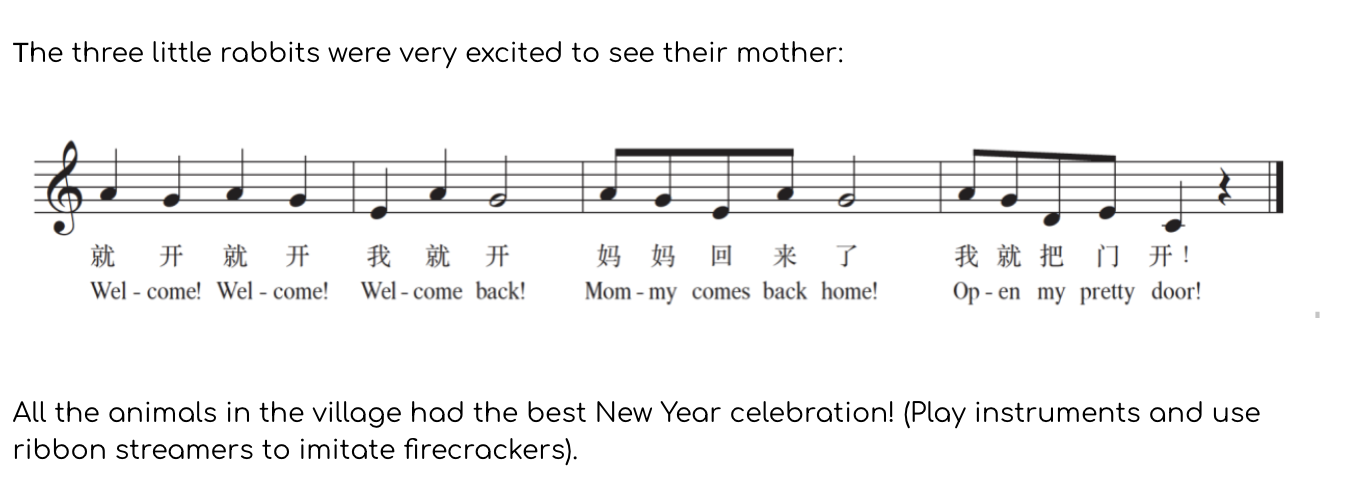
There is probably no other song more recognizable at Lunar New Year than Gong Xi, Gong Xi (Congratulations, congratulations!).
Many thanks to my friend, M. Kang, for sharing the English translation and the fan dance ideas for this song!
The full slide set is available here.


My sweet friend Melanie K. shared this with me and my students loved it. It is shared here with her permission.


The ending of a year is a contemplative time for me. Thinking about the past year leads to thoughts of what I want to change and improve upon in the coming year. This is a letter I have wanted to write for a while and one which I wish someone would have shared with my first year teacher self and continue to share with other music educators. I hope it encourages you.
To Whom It May Concern:
I don't teach music. I teach children music. There is a big difference in what and who is centered in those two sentences.
Teaching music begins not with the teaching of music concepts and skills, but with focusing on WHO we teach. Children first. That means that for most of us who teach elementary music, there is a steep learning curve in understanding the wide range of developmental ages and stages we teach. In a single classroom, we have at least five, and often MANY more various stages of typical childhood development. Add to that neurodivergence, medical and cognitive differences, social and emotional variances, and cultural and personality differences and there is much to be learned.
We have a responsibility as music teachers who teach a high quality music curriculum; a responsibility that allows all students to experience music from people around the world without bias. High quality music should not include music that is problematic, questionable, or racist. Do your research and don't rely on others to do it for you. Google is free and available for all. Music history, musicians, and music created by various identities, religions, and genders will be used in our classrooms. Identity formation is a critical aspect of social development in children as they develop sense of self, understanding, belonging, and acceptance. The idea that classroom curriculum should serve as "windows and mirrors" for children has been around for over 30 years - first coined by educator Emily Styles in 1988. Approaching children's music and music education through the lens of windows, mirrors, and sliding glass doors prioritizes diversity, honors cultural experiences, and promotes empathy and understanding. It also helps all children to feel included and a part OF, not apart from, as they see themselves in the music and musical experiences.
Our greatest responsibility is not in data collection, meetings, trainings, and PD's that are unnecessary, irrelevant, or do not promote the advancement of our craft and art. Our greatest responsibility is to help each child become the best version of themselves which means everything we do should be steeped in doing what is best for children, not adults. Children are at their best when they feel seen and loved. It isn't always easy to love and even like every child and the "prickly pears" and "frequent fliers" can be downright difficult. It isn't always easy to connect and be relational with every child. The reality is we sometimes struggle to find just one way to connect with a child. But to that child who finally feels seen it means the world. Find the one thing.
There are many outside forces demanding teachers time, talents, and energy. Music teachers don't stop being musicians or music teachers at 3:45 when they are "off the clock." Music teachers often teach private lessons or have secondary jobs directing ensembles or playing or singing in adult music ensembles. We often listen to music passively while wondering how to create a lesson to go with it. We have families and lives outside of school. Boundaries are necessary - hold to them and live your life. Stop comparing yourself to others and start advocating for yourself. Period. Do the next best thing for you.
Finally, be kind. To yourself, your fellow teachers, to your students, and to strangers. A kind word or gesture goes a long way in this filtered world where "likes" and "followers" dominate.
With much affection,