If you have spent any time here you know how much I love songs from around the world. I have two clapping song books from around the world, available from www.singsmileplay.com and am working on another book of singing games from around the world. SO much wonderful material and so many pathways to take with each song. Will it be a focus on beat, a specific rhythm pattern, melodic direction, form, expressive elements.... the list goes on and on!
Today I have a song to go with the book, "Around the World We Go" by Margaret Wise Brown, author of "Goodnight, Moon".
Though I can't include the lyrics, here is the song with a very accessible arrangement for Orff instruments. Create a B Section with word chains using country names and you have a very playable piece to accompany the book! Enjoy!
I love the facebook AOSA page! I also belong to the Kodaly Teachers, and Elementary Music Teachers and several other music teacher groups. Such a wealth of information and people sharing lessons and ideas! Just this month I found a wonderful idea using the book,"Giraffes Can't Dance" by Melissa Burroughs and she so very kindly gave me permission to share it with you.
Explore movements on index cards (whole class first), divide into
5 groups for our "Jungle Party"--each group has 4 cards to create a
unique jungle dance for their animals.
Melissa purchased these cards at Dollar Tree recently.
All groups practices together, then time for the party!
Each group performs by themselves (consider using "Bossa
Nova" from 'Rhythmically Moving 7).
With 5 groups and 8 beats between each group (play on drum or tambourine
as signal to change groups), this works perfectly.
Students share what they liked about each groups special dances.
Day 2
Explore animal names with one and two sounds (first grade) and
animal names that fit into rhythmic building blocks (second).
Compose 4 beat patterns (first) and 8 beat phrases (second).
Teach song add bordun.
Perform in rondo form.
Extension:
Create story where they tell
about one of their animal's adventure; where did it go?What did it do when it got there?
Well.. it's a nice saying but not entirely true-- the beat sometimes gets faster and rarely gets slower, but it does sometimes change. But let's not confuse the little ones - beat or pulse in a song stays the same.
There has been a lot of conversation on several facebook groups I subscribe to about using beat buddies AKA beanie babies or stuffed animals filled with weighted beads. These lovely critters make an appearance in my classroom quite frequently with my littles - I have Junior Kindergarten - 4 and 5 year olds and Kindergarten kiddos who really love them.
1. Oh the Horse Stood Around
2. Knees a Knees a Pizza Pie
Here is a previous post of another steady beat activity I use with my youngest students at the beginning of each music class.
Schedules, shmedules. They can be our best friends or our worst enemies. My schedule has changed this year; where once I had 2 grade levels a day and taught 3 third grades in a row, then 3 second grades in a row, I now am back to 5 or 6 grade levels a day. Thankfully I do have 5 minutes between, but we all know how quickly that will be eaten up by changing out materials, re-setting the room, dealing with behavior issues and teachers who are late to pick up students.
Here are a few ideas to help in those times of transitions.
1.
Rhythm of the
Day
Display rhythm of the day - use a 4 or 8 beat rhythm; could be related to new
song or review material.Students
memorize it- whisper to a friend or clap it , patsch knees, etc . Throughout the class, at various times, say "Rhythm of the Day" and students perform it back using body percussion. Prize/bragging rights/acknowledgement to first person who recognizes it from a song.
2.
Picture It
This is a great idea from my friend Laurie S. I am using it this year for sure! Music (or video of music) playing as students enter, one of the following four pictures displayed as they are entering the room. Laurie keeps the pictures on a music stand outside her classroom, as students enter they notice which of the cards is displayed. This could be a "turn and talk"/"think/pair/share" or could be used as a journaling activity if you use writing journals.
Globe - Listen for Location. Where is the music from? What languages are spoken/sung? How do the people use this music in their lives?
Style - What genre of music are they hearing? What kind of sounds and instruments are used? What is the mood of the music?
? - Solve the Mystery - Is it a capella, is it the star spangled banner, do you hear a certain rhythm, what are the dynamics, etc.
Instruments - What instruments are being heard? What family of instruments do they belong to. What kinds of materials do they use?
3. Figure/Reconfigure
Sing a familiar song
– Jingle Bells, Happy Birthday, Old MacDonald, etc.Clap and sing it.Figure out the rhythm and re-create the
rhythm.Create first couple measures of
favorite songs. Write out measures on white boards then mix up the measures. Can you sing it?
4. Brain Dance
My friend Debbie does this with her students at the beginning of each class and has the students offer music suggestions (of course she screens them for inappropriate lyrics before playing) to play.
Brain Dance is a full body/brain warm up exercise. Developed by Anne Green Gilbert, Brain Dance uses eight developmental movement patterns that healthy human beings naturally move through in the first year of life. Cycling through these patterns at any age, while sitting or standing, has been found to be beneficial in reorganizing our central nervous system. Students can perform the brain dance in a chair, on the floor or standing. This dance can be done to any song to fit your schedule. You will want to check out Anne Green Gilbert's site here. Here is a visual you can use with your students. Initially, I do the movements, once learned, two students at a time lead the Brain Dance.
Here are more specific examples for each movement listed above: Start by taking a couple of deep breathes. Squeeze, pat, and brush all over your body. Make a big shape and then a smaller one. Repeat a couple of times. Wiggle all over, make sure to move your spine. Move your upper half. Move your lower half. Move the left side of your body. Move the right side of your body. Use your eyes to track your hand up, down, right, and left. Bring your right elbow to your left knee, then your left elbow to your right knee. Lean over and swing between your legs. Spin in a circle. Repeat the other way.
Hello songs, review songs, Songs of the Month etc. are also good ways to establish routines at the beginning of class. Hope you enjoyed these!
A group of fellow bloggers are posting each day in July to gear up and rev our engines for the start of a new school year. Find us on facebook at Music Ed Blogs. Amazing group of teachers with fabulous blogs!!
Names, names, oh how special they are! And how tough for us music, art, PE, library, etc. teachers to learn the hundreds of them each year.
Here are a few activities to help you the first few weeks of school, and these are SO fun!! Pinkie swear promise!
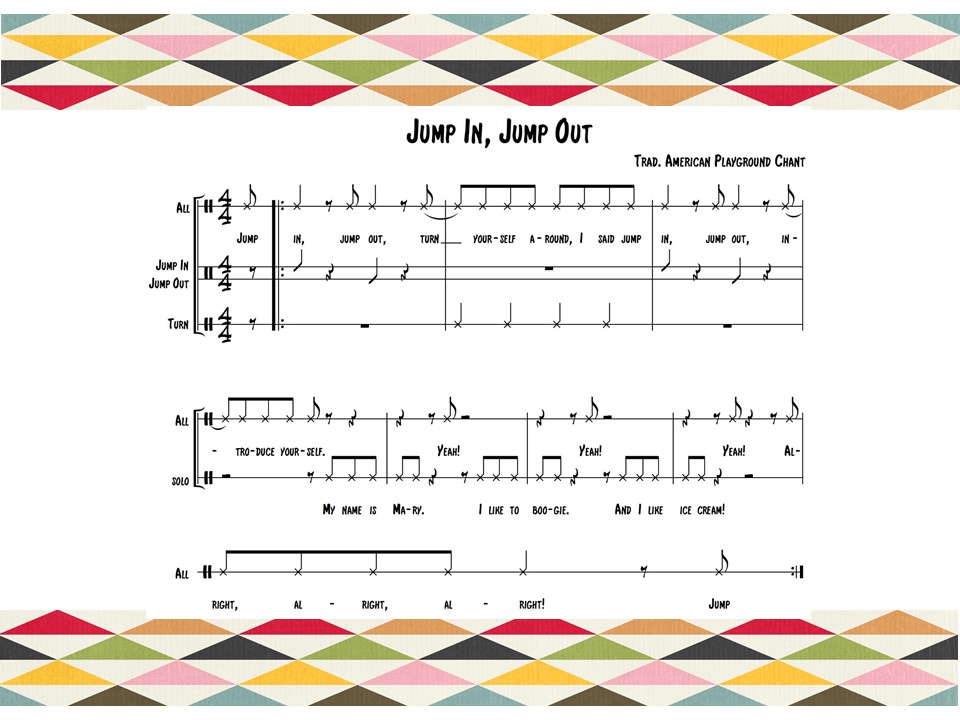
1. Jump In, Jump Out
There are many versions of this. I use the one from Laura at Make Music Rock.. She has a great blog post about this game! My older students love this one - maybe not for the very first activity the first day, but definitely sooner than later in the first lesson.
Here is a video of Laura's kids performing the game. I love it - fun and a little sassy.
Another version - love the Australian accent! I also love the beginning talk about the hand holding- very interesting!
2. Up the Ladder
From Randy and Jeff's Gameplan Curriculum, Grade 3, available here.
And check out the great extension using drums or UPP - again from Laura at Make Music Rock.
3. Hey, Children, Who's in Town?
4. Ickety Tickety
5. Name Game - The Original!
Remember this one? I do!!! Katie, Katie, bo-ba-tee, Bo-na-na fan-na, fo-fa-nee
Fee fi mo-may-tee Katie!
6. Dry Bones Come Skipping
7. I Can Say Your Name
8. Mrs, Macaroni
9. Names in Three
10. Willoughby Wallaby Woo! By Raffi
Willoughby wallaby woo
An elephant sat on YOU (point finger toward child whose name will be sung next)
Willoughby Wallaby Wistopher
An elephant sat on Christopher
11. Pig on Her Head by Laurie Berkner
Use the chorus of the song. A box of beanie babies are the perfect accompaniment for this one! Let each child choose; I usually put four or five on the floor at a time and invite three children up at a time (more choices than children, always). Begin by having the animal on children's heads, then sing, "Blakely has a goose on her hand....", and the next verse, "Thomas has a dog on his knee.. " etc. I love Laurie Berkner, if you don't already know "I Have a Chicken" you need it in your repertoire to use with shaker eggs. Hilarious!!!
Hope you have fun with these! If you know others, please share them in the comments below. Happy back to school!
From a fellow music teacher: I started classroom music teaching at the age of 40. It was only after I attended an Orff workshop that I knew I had found my teaching style. The rhythm of the words, the patterns and connections, the free flowing creativity, the movement, the instruments---all of those elements drew me to Orff.-MS
I am often asked, especially by new teachers, why Orff?
Orff Schulwerk (school work) is named after composer Carl Orff, who, along with his colleague Gunild Keetman, worked with children in post-war Germany. In the 1960's what became known as the "Orff Approach" spread the US and is joyfully embraced by teachers around the globe!
When I first began teaching music, (cough cough 24 years ago!) I was ill prepared to teach elementary age students. I had planned to teach high school choral music and only had one elementary methods class. During my student teaching experience I feel in LOVE with the wee ones and knew without a doubt that tying shoes, peeling toilet paper from shoe bottoms, and zipping zippers was in my future.
I felt a huge pull towards those beautiful Orff instruments, and bought a couple without really knowing how to use them.
If you were like me, you probably had the (common) misconception that the Orff Approach, was ALL about those beautiful xylophones, metallophones, and glockenspiels. Nothing could be further from the truth!!! Add in speech, singing, playing instruments (including Orff instruments), creative movement, improvisation, creativity, active listening, and hands-on music making and you have a very busy, fun-filled, playful music room full of happy, excited children who are collaboratively music making every day! It's a truly beautiful, magical music making experience!
For a history of how Orff and fellow teacher, Gunild Keetman, developed the methodology we now call the Orff Approach, check out the American Orff Schulwerk Association's page here. There is a fabulous 2 minute video at the top of the page, I've included another one below.
Speak, Sing, Say, Play
Teaching with Orff is similar to teaching children language and it is PLAYFUL! In music classrooms taught by Orff teachers you will hear children rhythmically speaking, singing, saying rhythms with body percussion and transferring that to unpitched percussion and pitched Orff instruments. You will see students creating their own music, playing and singing pieces in which they have participated in deciding how or what to play. You will see students dancing and creating movement to accompany a speech piece or a song. You will also see and hear elements of Dalcroze and Kodaly.
Imitate, Explore, Improvise, Create
Orff is process based, child-centered music education with imitation, exploration, improvisation and creativity at its core. Imitate/Explore
Students are taught using the sequence of IEIC; imitate the teacher, then move on to explore the piece of music. What if we played the A section 2 times? What if we spoke an ostinato over the rhyme? What if we played the ostinato on drums? What if we sing the piece in our heads and only sing the parts that have Mi Re Do? Improvise
Improvisation begins as students move from exploration into discovering new ways of doing things. Structure and form are still often provided; play the rhythm of 2, 4, 6, 8 on glockenspiels in C pentatonic. What is played is up to the performer; the rhythm (structure) is dictated as is the form (play the rhyme in full). Create
Students in Orff classrooms are often creating; small groups may be creating word chains that will be used as a "B" section in a poem or song. Students may be creating movement or ostinato to accompany songs or dances. I love the creative component and it is one of my favorite elements of Orff Schulwerk.
Don't Just Take My Word For It!
Orff is my passion; we are not called "Orff-Fans" for nothing! To give you a few more perspectives, I asked fellow Orff teachers about teaching with Orff - here's what they said: Most children can "Say"..Most Children can "Sing" & "Dance"..All Children learn through "Play"..the best teaching strategies I have ever come across! -LN I use the approach to guide my students into independent thinking as they create and note how much they enjoy the process. -KS Orff allows all children to have musical success at whatever ability level they are personally, all while also having fun! -RW My favorite thing about the Orff approach is that you start simple, allowing everyone the opportunity to contribute and participate with success. -KD
Have you tried an Orff workshop? I highly encourage you to "give it a go"! There is a list on the AOSA website, most chapters have between 3 to 6 workshops per year. Go, enjoy, and get ready to change your teaching forever!
Get ready for excitement, get ready for joy, get ready for fun!!